


The first half of the 2020s has been defined by a pace of change that has felt relentless. From Covid-19 and geopolitical tensions in the Middle East to the many changes of leadership in UK politics, the headlines are enough to unsettle even a seasoned investor.
The noise from these events, along with others, has led investment markets to yo-yo. When events outside of your control make markets volatile, it’s natural to question your financial strategy.
Indeed, you may feel the urge to “do something” in a bid to protect your assets. However, history reminds us that volatility is inevitable and markets typically bounce back stronger than before.
Learning how to tune out the noise may be easier said than done, but we’re here to help. Keep reading to discover why this is such a valuable skill and why staying on track could be the key to long-term stability.
Intermittent market volatility is normal
Conflicts, large-scale political events, and natural disasters can have wider consequences for the global economy. Even positive change can cause surprising ripples as investors tend to cling to certainty. However, such volatility is normal.
For example, in January 2025, Reuters reported that Nvidia – a tech giant responsible for manufacturing powerful computing chips – had experienced a dramatic overnight loss of $593 billion in market capitalisation. This dip followed the announcement of a new, lower-cost AI model by a Chinese startup.
But just a few months later, Nvidia made headlines by becoming the most valuable company in the world, with CNN stating it had achieved a market capitalisation of $4 trillion in July 2025.
Reporting at the time used an array of descriptive words to relay the news. Words such as “plummet” and “crash” are designed to elicit shock, but they’re often more noise than substance.
Though these events may feel nerve-wracking, market downturns and recoveries are far more common than most investors realise. Nvidia is just one example of a recurring pattern.
Data from Schroders, analysing the MSCI World Index between 1971 and 2023, presents a surprising but reassuring picture.
According to its research:
- Falls of 10% or more occur in 30 out of 52 years.
- Substantial falls of 20% or more occur in 13 years out of 52.
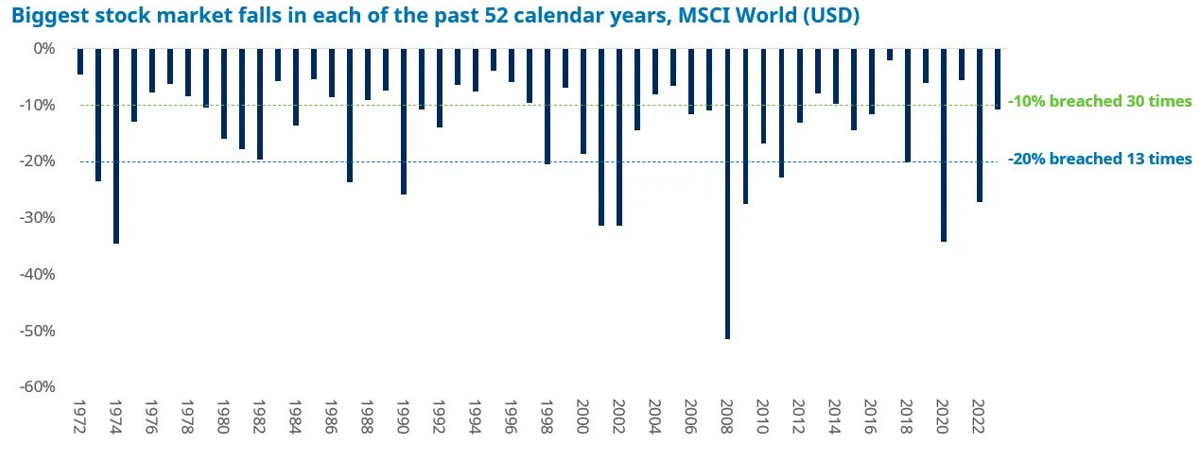
Source: Schroders
In the graph above, you can see just how normal market volatility is. Though these dips may feel scary in the short term, the market still trends upward over the long term.
Markets have achieved strong returns despite consistent noise since Covid-19
Despite persistent noise since the pandemic, markets have remained remarkably resilient. We’ve seen this play out even during periods of economic and political upheaval.
For example, JP Morgan’s Monthly Market Review shows that market returns have been positive across the board and relatively strong in part throughout 2026 so far, despite ongoing geopolitical tensions.
Here are several other examples of how the market has had strong returns since the pandemic, despite consistent noise.
- The S&P 500, which is often used as a benchmark for global equities, closed 2019 at around 3,231. It then fell by nearly 34% during the pandemic. However, by the end of April 2026, it had risen to 7,209, having recently surpassed 7,000 for the first time, marking a 123% gain in just over six years.
- The 2022 inflation spike and subsequent rate hikes from the BoE came as major shocks to UK equities. However, Trustnet states that markets have absorbed the rate-hike cycle, with the FTSE All-Share delivering a compound annual return of 6.3% from January 2020 to early 2025.
Despite wider economic uncertainties, key global indices continue to show that holding steady is key to growth, and exiting early can have a detrimental effect.
Exiting the market early means you miss out on a chance to recover
Humans are hardwired to avoid loss, and we tend to feel it more acutely than a gain of the same scale.
The theory of loss aversion explains this.
Developed by Amos Tversky and Daniel Kahneman in 1979, the concept highlights that people are more willing to take risks to avoid loss than to make gain. This is because the pain of losing something is psychologically twice as powerful as the joy of gaining the equivalent thing.
So, it’s no wonder that you’d be eager to escape this discomfort by selling off and exiting the market.
However, while this may ease your mind in the short term, it could have negative effects on your portfolio in the long term.
The research from Schroders shows that by staying invested during downturns, no matter how painful, your portfolio typically recovers faster than if you had left.
For example:
- Investors who moved to cash following the first 25% drop during the 1929 Wall Street Crash would have only recouped their losses by 1963. Investors who remained invested would have recovered by early 1945.
- Following the 25% drop in the 2008 financial crisis, those who exited would only have recovered their losses by 2024. Those who remained invested would have recovered their losses by 2013.
This shows that staying the course and remaining invested has historically been the quicker road to recovery, even after significant market downturns.
Indeed, market returns tend to be strongest after a dip. So, listening to noise and exiting means potentially missing out on a good recovery.
How we can help
Periods of geopolitical uncertainty can make the world around you feel unpredictable. Financial planning aims to counter that, and our goal is to help keep your finances predictable and secure.
Together, we’ll develop a plan that is built to support your personal goals and risk tolerance, keeping market growth and natural fluctuations in mind.
Our team of independent financial advisers in Lewes can support you with this, providing a calm and experienced voice in the storm.
To find out more, please get in touch by emailing us at financial@barwells-wealth.co.uk or by phone on 01273 086 311.
Please note
This article is for general information only and does not constitute advice. The information is aimed at individuals only.
All information is correct at the time of writing and is subject to change in the future.
The value of your investments (and any income from them) can go down as well as up and you may not get back the full amount you invested. Past performance is not a reliable indicator of future performance.
Investments should be considered over the longer term and should fit in with your overall attitude to risk and financial circumstances.





 Production